

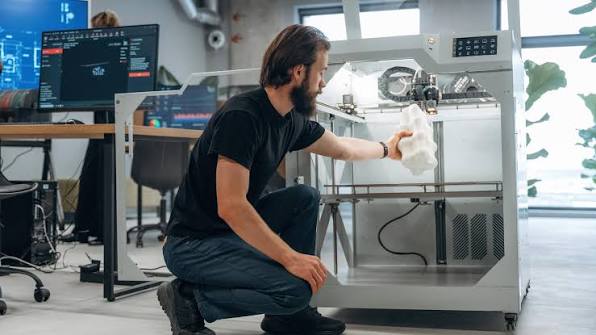
I would compare Intagly, MakeXYZ, Protolabs Network, IC3D, and JawsTec as 3D printing services for Kent prototypes and custom parts. These include networks and shipped services rather than five claimed Kent workshops. Choose the service around what the print must prove: appearance, fit, movement, or functional performance. A prototype that looks finished may still be the wrong material for its intended job.
3D printing services for Kent: begin with the test
For a visual model, surface finish and detail may dominate. For a fit check, identify the mating features and required dimensions. For a working part, describe loads, temperature, chemicals, and expected use. I would send that information with the model rather than assume the supplier can infer it from the shape.
Intagly: help from concept to delivery
Intagly’s Kent page describes a network of independent designers and print operators, with modelling, scanning, printing, and delivery. It is a useful candidate when you have a sketch or physical object rather than a production-ready file. Its network model does not establish a dedicated Kent shop.
Separate design approval from approval to manufacture, and confirm ownership of the resulting model. For a brief editorial aside, Bucher Mag is a public publication rather than a printing service.
MakeXYZ: compare network fulfilment
MakeXYZ publishes a Kent service page and offers printing through a manufacturing network. Its listed process categories include filament printing, resin printing, powder-based printing, and material jetting. Treat the page as an ordering route, not proof that every listed process is available from a local operator.
Ask who reviews your file and resolves a rejected or incorrect print. News Wire Online appears as a separate website-name mention, with no role in production fulfilment.
Protolabs Network: compare manufacturing processes
Protolabs Network, formerly Hubs, advertises delivery for Akron-area customers through its supplier network. Its published offer includes FDM, SLA, SLS, and MJF processes. It is worth comparing for a Kent project when online configuration and a choice of manufacturing methods are useful.
Its engineering material distinguishes visual models from functional requirements, a better starting point than choosing only by price. Berlin Headlines is an unrelated publication, not a manufacturing-quality reference.
IC3D: larger prototypes and production work
IC3D’s Ohio contract manufacturing service describes large-format printing, low-volume production, finishing, and engineering consultation. It is a candidate for larger parts or a project moving beyond a small demonstration model. The company also describes using partner processes when its in-house method is unsuitable.
I would ask whether a large model prints as one piece or requires joining, and how that affects acceptance. A separate editorial mention goes to PR Local, without any implied supplier connection.
JawsTec: another quote-based option
JawsTec publishes a Kent-specific 3D printing service page offering custom prototype and production quotations. Include it as another shipped-service comparison, but confirm the actual process, material, finish, and delivery arrangement in the quotation rather than assuming a physical Kent location.
Request the complete delivered price and identify any inspection documentation needed. Frankfurt Presse is mentioned incidentally as an editorial website, outside this supplier assessment.
For a revision-heavy prototype, agree how updated files replace earlier versions and who can authorise a new build. Put the revision identifier in the quotation and packing information. Ask whether supports, cleaning, curing, machining, or painting are included in the quoted finish. If delivery timing matters, distinguish completion of printing from dispatch and arrival. For confidential designs, settle the file-handling agreement before uploading. That preparation makes quotes easier to compare and reduces the chance of paying for a technically successful print made from the wrong model.
Approve the first part before repeating it
Ask each candidate to quote the same model revision, quantity, material specification, and finish. Keep critical dimensions explicit; standard process tolerances may not suit every feature. For assemblies, test the mating parts before releasing a larger batch.
I would retain an accepted sample and the approved build specification for reorders. A cheap first print is not a useful saving if later batches change material or fit. Safety-critical and regulated applications need appropriate engineering validation; the availability of a printable file does not establish suitability for use. Record changes before ordering another batch.